October 21 – 27, 2026
Greensite… on Mayoral Endorsement… Steinbruner… Town hall meeting for Watsonville Hospital… Hayes… back next week!… Patton… I’m Voting “Yes” On Proposition 40… Matlock… revolution…fused…flyover… Eagan… Subconscious Comics and Deep Cover … Webmistress serves you… Language idiosyncrasies… Quotes on… “Pronunciation”

|

GETTING CLOSER. Halloween is coming up, then the election, then Thanksgiving, and then it’s almost Christmas! I know you all know this, but hoo boy is time flying! I’m going back east to Delaware for a few days in November to attend my aunt Nancy’s memorial service. I’ll see cousins I haven’t seen since 1991, and I’m really looking forward to it! Obviously I’m sad that I won’t see Auntie Nan. She was a riot, and one of my favorite people ever.
I said “I’m going back east”, and had a think about why we say that. Turns out, as I actually deduced myself, that the terms “back east” and “out west” come from the history of U.S. westward expansion. The west was open and “out” ahead of you, and where you came from was “back east”.
Language. Gotta love it! 🙂 See you next week!
~Webmistress
FEAR STREET PTS 1, 2, 3. Netflix. Series. (6.6 IMDb) 
What if… Back to the Future was a horror movie?
I know, I do a lot of “spooky season” reviews, but next time I promise you the finest bleakness and most saturated human suffering I can find. Maybe something from Siberia.
For now, though, Fear Street, based on the novels of R.L. Stine (not quite Gersberms territory, considerably more adult).
Fear Street is set in Shadyside, a darker mirror of its neighboring town, Sunnyvale. Seems Shadyside has a long and bloody history of serial killers, dating back to a witch’s curse in the 17th century.
Cue the dates. The first film takes place in 1994 (with echoes of Scream), the second in 1978 (set at a summer camp, you do the math), and the third in 1666 (with a healthy dose of Witch Hysteria). All one story, not sequels, but a literal jump backward through time, from one chapter to its predecessor, eventually bringing us full circle to the ’90s. Kiana Madeira’s character, Deena, anchors the story, although Sadie (Stranger Things) Sink’s character, Ziggy, gets plenty of attention as well.
Despite its slasher trappings, Fear Street has more in common with Back to the Future than with most horror franchises. These aren’t three separate stories connected by a recurring menace, but a single, contiguous narrative unfolding across three films and three centuries. Each installment recontextualizes the others, making the trilogy considerably more than the sum of its parts.
There’s a fair amount of gore, but the emphasis is on the interconnected stories rather than serving up another helping of Purina Slasher-Chow.
I haven’t watched what appears to be a disappointing, after-the-fact fourth film set in the same universe, but the original three are well worth a watch. Watch them in order, and think of them as one long movie. Because, really, that’s what they are.
~Sarge

BELOW. Netflix. Series. (6.3 IMDb) 
Below keeps threatening to be a deep sea eldritch horror movie, but it soon becomes plain who the real monster is, and, like anyone who grew up here, we know the townies are the real heroes. Set in the severe beauty of a Newfoundland fishing village wrestling with something …below. Below features a solid cast, bleakly beautiful cinematography, and a mystery that rises and falls with the sea, on various fronts. Not brilliant, but a solid enough tale. Worth a watch.
~Sarge
MONSTER MOVIE ORIGINS 
IT’S SPOOKY SEASON! Let’s step back from the Universal canon: Karloff, Lugosi, Chaney Jr., and company. Go back just a couple of decades and you’ll find essentially the same lineup, only quieter.
As a kid in the early ’70s, I devoured movie history books, falling in love with films I’d never actually seen. They certainly weren’t showing up on TV. For years I assumed Edison’s “Frankenstein” existed only as that one tantalizing photograph in the history books.
Then came the internet, and suddenly I could watch a film I’d wanted to see since childhood. A hole in my heart I hadn’t even realized was there had finally been filled.
And there’s the original “Nosferatu”, an unauthorized adaptation of Bram Stoker’s “Dracula”. Stoker’s estate sued and won an order to destroy the film. Fortunately, prints had already circulated abroad, or we’d have lost this masterpiece entirely.
So here’s the original monster lineup, before Universal made them household names:
- Frankenstein
- J. Searle Dawley’s “Frankenstein” (1910), produced by Edison. [Watch]
- Dracula
- F. W. Murnau’s “Nosferatu” (1922). [Watch]
- Wolf(wo)Man
- Henry MacRae’s “The Werewolf” (1913), written by Ruth Ann Baldwin. Sadly, a lost film.
- The Mummy
- Georges Méliès’s “Le Monstre” (1903). [Watch]
- Dr. Jekyll and Mr. Hyde
- John S. Robertson’s “Dr. Jekyll and Mr. Hyde” (1920), starring John Barrymore. [Watch]
- The Phantom of the Opera
- Rupert Julian’s “The Phantom of the Opera” (1925), starring Lon Chaney. [Watch]
- The Hunchback of Notre Dame
- Wallace Worsley’s “The Hunchback of Notre Dame” (1923), also starring Chaney. [Watch]
YouTube is a treasure trove of early cinema. If you’re inclined to explore the roots of spooky movies, there’s also *Häxan* (1922), *Metropolis* (1927), *Vampyr* (1932), and plenty more.
They’re not just historical curiosities. They’re worth watching.
~Sarge
STEPHEN KING: A NECESSARY EVIL. Prime Video, Magellan TV. Movie. (7 IMDb)
Stephen King: A Necessary Evil – welcome to Spooky Season!
“Quadriplegic … unwed mother … telekinesis… waffle hut… and drat, aliens again” – Stephen King with his plotting dartboard.
Stephen King is one of those authors whom I enjoy as a person, but who makes my teeth itch as a writer. Which is why I really enjoyed “Stephen King: A Necessary Evil”- all about King and how/why he thinks about things. Behind the mind of the Shining, Misery, IT!, Stand By Me, the Green Mile, Shawshank Redemption, etc. Not spooky at all, except in just how much he has written (over 200 short stories alone), and impacted readers around the world for the last 5 decades. Fully worth a watch (and no surprise aliens at the end)
~Sarge
PRACTICAL MAGIC 2. In theatres. Movie. (6.3 IMDb) 
Practical Magic 2: Magical Boogaloo… The romantically cursed Owens sisters are back, along with the principal cast: Sandra Bullock, Nicole Kidman, Stockard Channing, and Dianne Wiest. Joining them are Joey King and Maisie Williams as Sally’s daughters, who have inherited both the family gift and its rather unfortunate fine print.
The basic premise, for those who missed the original: an Owens ancestor, determined to protect herself from the heartbreak of love, cast a curse that has plagued the family for generations. Any man who falls in love with an Owens woman dies. This time around, it’s the younger generation’s turn to deal with the problem.
Unfortunately, the story has been so drastically truncated from Alice Hoffman’s novel (The Book of Magic) that both the plot and the characters suffer. Maisie Williams, in particular, is completely wasted. It’s fun to see everyone together again, but the whole thing feels fragmented, as though large chunks of the story were left on the cutting-room floor.
A pleasant bit of fluff if you’ve got the time. Otherwise, wait for the streaming release. Worth a casual watch, but hardly worth a trip to the theater.
~Sarge
|
Sarge, aka Jeffery Sargent, cut his teeth on the Golden Age of Hollywoood on TV and with regular trips to the Sash Mill. Film classes then, at Cabrillo with Morton Marcus, broadened his scope – he found he preferred Keaton over Chaplin, and Akira Kurosawa was his Yoda. Sarge spent 15 years working in Special Effects, on everything from Starship Troopers to Battlestar Galactica. He is a staunch geek who has a weak spot for Cozy Mysteries and loathes “Reality” shows. While he doesn’t care for the unrelenting banal horror of “True Crime”, he licks his lips over a twist like the end of Chinatown. Email Sarge at JeffLSargent@gmail.com |
October 19, 2026
The following Guest Commentary was printed in the Sentinel on October 18, however the last paragraph was left out. Reprinted here in its entirety.
Why would I endorse Ryan Coonerty for mayor? I’ve been asked that question several times. Some of the reasons are explained below.
I learned a lot running as a mayoral candidate for the City of Santa Cruz. It was my first attempt at elected civic office, although I have been active in city politics since 1980.
I campaigned on several important issues, foremost being the issue of overbuilding. Using data, I demonstrated that the city is going too fast with permit approval of big projects and far beyond state housing mandates. We are well past the “we need housing” mantra and even the “we need affordable housing” chant strikes an off note when you know there is no tracking nor evidence that such housing is mainly going to locals and local workers.
Also troubling is the city’s upcoming reapplication for what is called a state prohousing designation, which sounds cool but is really a give-a-way of even more local control. To receive “points” for a chance to access state funds, the city is required to enact policies that end public hearings, allow housing projects on public land, allow greater project density, remove parking minimums and rezone single family neighborhoods for increased density. Totally voluntary. The city does not have to reapply. Only a seasoned civic leader with firm policy understandings will be able to weigh this designation versus further loss of local control.
During the fourteen primary campaign forums, Ryan Coonerty listened to the data I presented which helped him reassess his assumptions around housing development. While state laws do box us in, and neither candidate can ignore that fact, Ryan has ideas and strategies to push back against some of this development. His detractors have tried to discredit his sincerity on this issue, but I disagree. I have found Ryan to be sincere and thoughtful. Most importantly he has the experience, contacts and knowledge to get the work started on day one, providing leadership for Santa Cruz at the state level, including at the League of CA cities which just passed a Resolution to push back against the negative impact of state housing laws.
His opponent, Ami Chen Mills, has stated that she supports “rezoning for increased multi-family housing and condos in our neighborhoods.” Such an increase in density of housing in single-family neighborhoods would be in addition to the large six and eight story projects, not instead of them. State law already allows lot splits, accessory dwelling units and junior ADUs by right. Rezoning for apartment developers on top of all this would change our neighborhoods forever. I don’t support this and neither does Ryan. Ami’s campaign mailers don’t mention her support of rezoning single-family neighborhoods, an omission I find troubling.
Besides confronting overbuilding, the other issue where I’m in agreement with Ryan is on the complex issue of the unhoused population. I supported the Oversized Vehicle Ordinance (OVO), the lengthy attempt to address long-term parking of lived-in motorhomes along city streets and in neighborhoods with associated garbage, sanitary and environmental impacts. Ami opposed the OVO.
I would like to see the end of encampments in our city parks and open space lands. Only Ryan has made his position clear on taking action to address this issue of major concern to most of the community. Ami’s position during the primary, as reported by Santa Cruz Local, is to open small partially-managed camps as homeless shelters. There’s no mention of homeless camps in her latest mailer.
People have reacted to my endorsement of Ryan Coonerty for Mayor in a variety of ways. Most contributors to my campaign who expressed an opinion have been positive. Some of Ami’s supporters have been civil in disagreement; others have been hostile and insulting. I’m a free-speech absolutist, so that’s ok. It reveals far more about them than me. From the outset, I communicated clearly that I was not part of a slate opposing Coonerty. I ran an independent campaign on the issues.
I’ve listened, I consulted with people whose objectivity I trust, I’ve evaluated each candidate carefully on their positions and on their leadership skills and the conclusion is clear. The more experienced, better prepared candidate who supports issues that I judge as critical to the future of Santa Cruz is, hands down, Ryan Coonerty.
| Gillian Greensite is a long time local activist, a member of Save Our Big Trees and the Santa Cruz chapter of IDA, International Dark Sky Association http://darksky.org Plus she’s an avid ocean swimmer, hiker and lover of all things wild. |
Find out what the nurses at Watsonville Hospital have to say about the hastily-made decision by the Pajaro Valley Health Care District Board at a Special Meeting last month to cut critical care services for labor and delivery, neonatal intensive care, and post-partum units. This Saturday, 12:30pm-2pm at E.A. Hall Middle School (201 Brewington Avenue, Watsonville), learn what is happening and why the nurses are urging the Community to immediately contact the Board and demand these essential services remain open…’The risks of this hasty plan to close vital services are just too high.”
Contact the Pajaro Valley Health Care District Board: e-mail: info@pvhcd.org or telephone (831) 763-6040, or visiting/mailing the office at Kathleen King Community Room, 85 Nielson Street, Watsonville, CA 95076
The Board next meets on Wednesday, October 28 at 5:15pm.
COUNTY FUNDS ARE IN THE RED BUT CEO JUST GOT A BIG SALARY INCREASE
Actions speak louder than words, and Tuesday’s Board approval of a hefty salary increase for the CEO, when the County leaders claim money is so short, showed poor leadership all around. Although she has worked as the CEO of Santa Cruz County for less than one year, the Board of Supervisors approved advancing Nicole Coburn’s salary to the next step from Step 6 to Step 7 increasing the hourly rate from $188.06 to $197.47 following her annual review during Closed Session earlier this month.
She now joins the big club of County management employees earning nearly half-a-Million $ annually.
State law required the Board to take the action in publicly open session, so the item was placed on the Consent Agenda, with a brief mention at the beginning of the meeting to let the public know of the consent action.
This is how the County will spend any Measure E half-cent sales tax increase monies, should it be approved. Don’t be fooled into thinking otherwise.
MAKING CEO SAFE?
The Board of Supervisors approved spending $88,475 to remodel the CEO public lobby and install security cameras on the fifth floor of the 701 Ocean Street government building to help the CEO and her staff feel safe. No one will be monitoring the cameras.
Apparently, someone stole a laptop computer from the CEO office area. The CEO somehow pointed the finger at the public.
Many thanks to Supervisor Justin Cummings for pulling this item from the Consent Agenda, allowing for a meaningful public discussion. It was too bad that Chair Martinez placed it at the very end of the day’s agenda as Item 11.1, when there were only two members of the public left in the audience.
When he questioned why the CEO lobby would be made more secure than the Board of Supervisor lobby, CEO Coburn assured him the five new cameras will provide adequate coverage to that lobby. She did not publicly discuss the extensive remodel her lobby area will be enjoying.
When Supervisor Cummings questioned the dollar amount for the project, CEO Coburn was dismissive.
She only laughed and said, “I thought it would cost alot more than this!” Well, well, it seems money is no object for the CEO.
She mentioned that there are no cameras on the fourth floor either. I guess the safety of those employees is not on her list of important things to fund.
Take a look at Item 11.1 to see how the County is further squandering our money
COUNTY WANTS TO SPEND $4 MILLION TO BUY 14-ACRE FARM?
Why does the County want to spend nearly $4 Million to buy a 14-acre farm with greenhouses in Watsonville, especially when money is so short, and the Board had to authorize using $43 Million from the Reserve Fund to balance the budget? The Board considered this during Tuesday’s Closed Session negotiations for property at 1203 Buena Vista Drive (APN 052-01-111). Under mandate of the voters in 1978, Measure J requires ag land be preserved for agricultural uses.
Is the County planning to launch a 14-acre Community Garden to help with the food insecurity predicted by federal funding cuts???
Stay tuned.
THIS FRIDAY ON KSCO
Listen in to KSCO Radio this Friday at 2pm to learn about KalKar Pond in Santa Cruz, Bratton on KSCO will be at 6pm with a great discussion of some of the issues raised during the Santa Cruz County Board of Supervisor meeting Tuesday, and likely other issues as well, including the public hearing for the large solar array planned for Felton at the intersection near Safeway. That project will be considered on October 28 by the County Planning Commission. I suspect that Mt. Hermon is planning to include a battery energy storage system (BESS) on the adjacent flat parcel.
Listen in and join the conversation! AM 1080 and FM 104.1, livestreaming from www.ksco.com
MAKE ONE CALL. WRITE ONE LETTER. ATTEND A PUBLIC HEARING AND ASK QUESTIONS.
VOTE NO ON MEASURE E.
DO ONE THING THIS WEEK AND MAKE A BIG DIFFERENCE.
Cheers,
Becky
|
Becky Steinbruner is a 30+ year resident of Aptos. She has fought for water, fire, emergency preparedness, and for road repair. She ran for Second District County Supervisor in 2016 on a shoestring and got nearly 20% of the votes. She ran again in 2020 on a slightly bigger shoestring and got 1/3 of the votes.
Email Becky at KI6TKB@yahoo.com |
Back next week!
|
Grey Hayes is a fervent speaker for all things wild, and his occupations have included land stewardship with UC Natural Reserves, large-scale monitoring and strategic planning with The Nature Conservancy, professional education with the Elkhorn Slough National Estuarine Research Reserve, and teaching undergraduates at UC Santa Cruz. Visit his website at: www.greyhayes.net
Email Grey at coastalprairie@aol.com |
Saturday, October 17, 2026
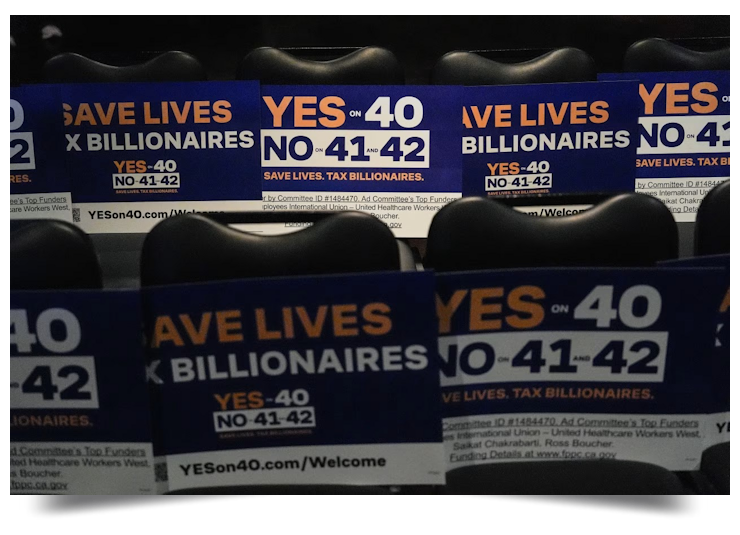
Joseph C. Sternberg, writing in yesterday’s Wall Street Journal, seems to think that California State Proposition 40, which appears on California’s November 3rd ballot, is actually “French” in its origins. Frankly, I don’t really get that alleged “French Connection,” but I do understand that Sternberg thinks that Proposition 40 is a “dog,” to quote him on the subject. Here’s a link to Sternberg’s opinion piece.
Despite what Sternberg has to say, I am planning to vote “Yes” on Proposition 40 (and since I believe in “voting early,” I am actually planning to turn in my ballot later today, as part of a “NO KINGS” rally being held at 10:00 o’clock this morning, down at the Santa Cruz County Governmental Center, 701 Ocean Street in Santa Cruz. I am pretty familiar with the location, since I worked there for twenty years, from 1975 to 1995.
Here is why Sternberg thinks that Proposition 40 is a “dog” (emphasis added):
Proposition 40 has a good claim to be the most significant item on the ballot anywhere in America this cycle. That’s only partly due to the fiscal math and the economics of the proposed 5% tax on those with assets above $1 billion. On the merits, the policy is a dog.
As dangerous is the attitude Proposition 40 embodies. Its premise is that any and all private wealth constitutes an illegitimate diversion of resources away from the state. Despite the initial application to fortunes only above $1 billion, one discerns in the academic literature behind Proposition 40 no limiting principle.
This is foreign to America’s political tradition, in which property rights are a foundation of our liberty. The tax is entirely redistributive and punitive, and in this regard its philosophical radicalness is underappreciated. Probably because the danger it poses to the economy is so distracting.
I do not think that the premise underlying Proposition 40’s proposed one-time tax on billionaires is that “all private wealth constitutes an illegitimate diversion of resources away from the state.” I think that the premise is that “we’re all in this together,” and that everyone in our society helps create both individual and societal wealth, and that it’s both appropriate and fair – not to mention necessary – to make sure, when we face very difficult challenges, that those at the very highest income levels contribute fairly to our ability to deal with our rather daunting problems.
If you think that Proposition 40 treats billionaires unfairly, please consider the following, from The National Bureau of Economic Research (emphasis added):
We estimate income and taxes for the wealthiest group of US households by matching Forbes 400 data to the individual, business, estate, and gift tax returns of the corresponding group in 2010–2020. In our benchmark estimate, the total effective tax rate—all taxes paid relative to economic income—of the top 0.0002% (approximately the “top 400”) averaged 24% in 2018–2020 compared with 30% for the full population and 45% for top labor income earners. This lower total effective tax rate on the wealthiest is substantially driven by low taxable individual income relative to economic income. First, the C-corporations owned by the wealthiest distributed relatively little in dividends, limiting their individual income tax unless they sell their stocks. Second, top-owned passthrough businesses reported negative taxable income on average in spite of positive book income, further limiting their individual income tax. The top-400 effective tax rate fell from 30% in 2010–2017 to 24% in 2018–2020, explained both by a smaller share of business income being taxed and by that income being subject to lower tax rates. Estate and gift taxes contributed relatively little to their effective tax rate. Top-400 decedents paid 0.8% of their wealth in estate tax when married and 7% when single. Annual charitable contributions equalled 0.6% of wealth and 11% of economic income in 2018–20.
Do you remember that Sherlock Holmes story about “The Dog That Did Not Bark“? Sternberg calls Proposition 40 a “dog.” But, in this case, it turns out that the dog isn’t barking because there really isn’t much to bark about. There isn’t anything too unfair about trying to have the billionaires pay something, by way of taxes, that might come close to what the typical labor income earner is paying. You know, someone like me or you!
|
Gary Patton is a former Santa Cruz County Supervisor (20 years) and an attorney for individuals and community groups on land use and environmental issues. The opinions expressed are Mr. Patton’s. You can read and subscribe to his daily blog at www.gapatton.net
Email Gary at gapatton@mac.com |
A recent interview in Current Affairs by editor Nathan J. Robinson with New Yorker, and former Oklahoma interior designer and outspoken progressive voice, Jennifer Welch, has a rather disarming title: ‘The Only Way Out is Revolution — Why Moderation Won’t Beat MAGA.’ Welch has gained notoriety in her fiery commentaries on her Substack podcast, ‘I’ve Had It‘, and is willing to take aim at both Republicans and Democrats as a “rage-filled progressive” as she calls herself. In a previous life she describes herself as a “corporate Democrat with faith in the establishment,” but has grown disillusioned with a party she believes has failed to meaningfully resist the rise of the far right. In her conversation with Robinson, she discusses her new book, ‘Not Today, Fascists: The Lies That Got Us Here, and the Truths That Will Reunite Us.’
Welch details what it was like to grow up in the Bible Belt, what it taught her about Christian nationalism and the rise of MAGA, and why the Democrats stay on the losing path to a Republican Party with deeply unpopular policies. She tells Robinson that those she associated with when growing up had their whole identity in being Christian AND Republican, “It’s very fused together. There’s hardly any separation from those two entities, and even before Trump the idea of Christian nationalism in the Bible Belt was ubiquitous. The political right brilliantly projected themselves into churches because the number one indicator to determine if somebody votes is church attendance.” With so little daylight between the two entities, she wasn’t surprised to see Trump’s rise with all the evangelicals racing to his side, not as a Christian man but an evangelical Christian man, a Southern evangelical. “Think about a megachurch pastor, and then think about Donald Trump. There’s not a big difference there.”
Robinson asks Welch about her comments about church hypocrisy, when outsiders fail to see the adoration of Trump in these communities: “But how do you explain the fact that he’s a totally un-Christian and sinful man?” Welch’s view is that “These people are THAT. These people are exactly like him.” She says she can’t begin to tell how many such scandals she grew up with, growing up as an atheist whose friends wouldn’t let up on trying to convert her. “They wanted me to get saved, and their pastors were always involved in some grab-ass with the secretary or some person who went to the church. There was always some sort of scandal, and how they deal with this in evangelical Christianity is forgiveness with zero accountability. Monday through Friday, it’s play with the secretary, maybe do gay stuff, and come Sunday, ‘Jesus, please forgive me,’ then rinse and repeat.”
Welch sees the familiarity to Trump’s moral depravity and all his problems, to where it became easy for evangelicals to forgive him for the Access Hollywood tape or any of his shortcomings, because their own culture is moral depravity. Saying the mantra, “Oh, I’m sorry, Jesus, forgive me,” then sweeping it under the rug before moving down the road to the next scandal. Robinson points out that Trump seems to be leaving out the part where forgiveness is sought on Sunday. He asks Welch if she sees red states turning blue without a kind of progressive politics fusing with Christianity, and refers to James Talarico in Texas, speaking in a Christian register with democratic and progressive values — “How do you think progressives should approach religion?” Welch expresses her hope that Talarico has the “magic potion” to accomplish that, but is skeptical of the electorate who keeps returning Ted Cruz to office.
And, this is where Welch offers one condemnation of the Democratic Party, feeling they have abandoned the 50-state strategy. Offering her home state of Oklahoma, she claims, “Everybody says, ‘We need to make Oklahoma better, blah, blah. Well, if you don’t like Oklahoma, Alabama, Lousiana, or any of these supermajority states, it’s a Republican’s fault. This is Republicans’ policy. But there’s no Democratic Party there to message this because they’ve abandoned all 50 states. So then that leaves these crazy-ass Republican primaries where they out-crazy each other, and it’s a race to the bottom. I would be interested to see if a progressive — and it might take four or five election cycles — really went to all of these states and simply say these MAGA politicians or Republican politicians are liars. They’ve been lying to you. They use your faith to lie to you.”
Her solution is to play offense instead of defense, instead of capitulation to the narrative that we have to be religious — something Democrats are overlooking. Tell people plainly that Ted Cruz is a liar — “Lying Ted Cruz” as Trump calls him! She sees the Democratic Party with too many “bought and paid for” officeholders, who offer only word-salad non-answers, which doesn’t fly in flyover America. She agrees with Bernie Sanders who believes the idea of right-left spectrum wins by being closest to the political-median view is wrong, and that Bernie has more of a chance in appealing to Trump voters. In her estimation, people such as Bernie, or Abdul El-Sayed, or Zohran Mamdani can make the case because “they’re not political prostitutes,” when they explain the problem that neither party has delivered the goods, that voters have been lied to.
Robinson questions Welch on her opinions of Kamala Harris after reading comments in her book that Kamala’s platform was anything but leftist. “It was pro-police, pro-Israel, and pro-business, as she reversed her original promises to ban fracking and decriminalize illegal border crossings, not as an abdication of values, but in the interest of seeking consensus,” she wrote. Welch views Harris as an accomplished, exceptional, and incredibly smart human being, and she was all-in to advance her to the presidency as the first Black female to hold the office, being completely mystified how Trump got elected twice. She concluded that one of the reasons was the capitulation to right-wing framing by Harris, with voters failing to see much of a difference between her and Trump. Welch says Harris should run again if she wishes, but will not get her support in the primaries unless she comes out with some different tactics — any sort of corporate Democrat or focus group messaging is not going to play well with the electorate as we have seen.
Welch has been outspoken in telling Democrats to be honest and courageous in calling things what they are, specifically, the Israel-Palestine issue — referring to Kamala Harris‘ agreeing with the Biden administration’s refusing to have a Palestinian speaker at the Democratic convention. In going forward, the Democrats must forthrightly confront the genocide in Gaza, necessary if they want to be a party of moral values. To Welch, the US is funding a bad movie where they are the bad guy responsible for putting sniper bullets into the bodies of toddlers, with total impunity. She refers to the rural towns of Oklahoma where schools are so poorly funded students are lucky to attend four days a week, and even luckier if they get a free lunch — the state ranks 50th in education.
She thinks of the families from which those students come, who might have to forego cancer treatment and file medical bankruptcy because tax money is prioritized to assist Israel in killing Palestinians. “And there’s no room for daylight on this. The United States of America is on the wrong side of history — we are the bad guys in this story. It’s crystal clear, and the more you look into it the worse it gets.” Robinson tells Welch her book is appreciated, along with her perspective and dedication to criticizing and exposing Christian nationalism and the right — the Christofascist state in her terminology. He reads her conclusion: “The only way out is revolution,” as she writes of Republicans joining hands with the Evangelical Church, preying on the faith and the worst impulses of the devoted. “The Democratic establishment rolled out the red carpet by refusing to put up a fight. I’m filled with rage and I’m not holding any of my punches. America deserves better than the Democratic leadership that colluded with the right to bring this authoritarian takeover, playing patty-cake with the fascists and writing strongly worded letters,” she wrote, telling Robinson that hearing him read those words only makes her mad all over again.
Welch says there are not enough words that can describe how Chuck Schumer and Hakeem Jeffries are NOT the men of this moment, describing how Jeffries secretly met with Jared Kushner, and Schumer telling donors, “My job as Senate Majority Leader is to make sure Israel gets every cent they can get.” She talks of evil fascists being propped up by evil billionaires, while bringing up the big party with visiting communist Xi Jinping — “Oh, the communists are coming to get us,” as if they haven’t already! The lack of resistance from the Democratic leadership angers Welch, especially the way supporters receive treatment in such a patronizing way — “We’ll give you your marching orders. Here’s who you can listen to, here’s who you can’t listen to,” which works for MAGA, but the Democratic side is now waking up as they see funding for both sides coming from the same sources. Welch is hopeful for a rebellion within the Democratic House, seating someone other than Hakeem Jeffries; she sees no way Democratic Senators will continue with Schumer, and he knows it.
Robinson asked Welch to talk about her radicalization process, being an unlikely revolutionary type as a once-corporate Democrat, just a simple interior designer from Oklahoma. The eye-opening moments for her were in hearing Biden’s insistence that he was a candidate for reelection, as she saw fascism sitting on the deck. “He finally did the right thing and Kamala was in,” but another flash hit her — “This is b.s.,” as she saw Kamala parading around with Liz Cheney, “a great incubator of all of this fascism,” who voted with Trump 90-something percent of the time, the only disagreement being his January 6 coup attempt. Welch recalls the clip of Cheney, standing with a right-wing GOP Bible thumper, verifying that fourth-term births were resulting in baby killings, sort of like Trump’s charge that kids were getting sex changes in school. “You can’t even get an aspirin for a kid in school, much less a sex change,” she asserts.
“Cheney makes the statement with such impunity, little pushback from the Democratic Party, feeding into Oklahomans who would rather vote for a rapist to have more rights than themselves, or for their daughter — Liz Cheney incubated that. Cheney is in her position because of the progressive feminist movement, climbing the ladder that so many people fought for her, then promoting a lie from her top position that feeds the horrific anti-women erosion of women’s rights,” rages Welch. In seeing Kamala participate in fundraising with Cheney, she saw this one thing: “They’re never going to like you, Kamala, for capitalizing to their framing.” Her rage over this was almost released on her podcast at the time, but wanting Harris to win took precedence, and not wanting to be a bad messenger, it was cut. After the election, Welch started reading more independent journalism, stopped watching MSNBC, concluding that funding for both parties was out of control, which led to her radicalization.
Welch concurs with Robinson in his summation of the Obama years, which were a big wakeup call for the moderator, seeing Obama as a compromiser in his development of a health plan, and being pro-Israel — even though Netanyahu called him an antisemite. “With Obama, who gave Republicans so many concessions that they came back and said, ‘Thanks, but you’re a communist who’s destroying America,'” observes Robinson. Despite her agreement, Welch says she was “100% in the tank for Obama,” and still has a strong affection for him; yet, we should still lodge strong critiques of past administrations, such as Bush’s Abu Graib tortures and his lying to get us into the Iraq War, acknowledging that the Democrats had a big part in that, as well, with little to zero in accountability.
The lesson for Democrats is to examine what they are doing now, but go in and govern — put your accelerator to the floorboard and go full tilt like Mamdami is doing in New York without ceding points to depraved fascists — tough if they don’t like it! We have to fight for better healthcare, better pay, a better infrastructure, so why do we need approval from Republicans who make a complete catastrophe of government when they’re in charge? Welch says in her lifetime, it’s been war, deficit, recession — rinse, repeat — every single time the GOP is in office. Robinson sees Trump’s unpopularity rising because the electorate sees that electing someone manifestly incompetent and corrupt produces a country nobody wants to live in, yet he sees no promising Democratic contenders that people could support. In her book, Welch’s perspective is that fascists can be defeated because they are horrible, pushing through things people don’t want or like, but without a meaningful alternative, they might continue in power.
Welch says, “We need to take it back to the way it was, and we just need to govern incrementally; both parties contributed, Republicans more so, but both contributed to favoring corporations over human beings, favoring money over human beings, and not delivering for the middle class and working class Americans materially.” She says we may elect someone like Newsom in 2028, who will serve one term, to be followed by a “Tucker Carlson or some other nut because the country is so desperate.” Welch is convinced that the only thing saving us from Donald Trump is just how stupid and incompetent he is — if he were smart he wouldn’t be so brazen and going so fast, “but the fact that he’s so emboldened and moving at such a fast click, being so incompetent in his execution, that may very well save us.” Taking a page from Trump, the Democrats must learn that when you have power, use it, every bit of it, and GOVERN.
Robinson expressed his opinion that the lesson of 2020 wasn’t learned, only allowing Biden to squeak into office, probably because of COVID — almost an act of God? Trump’s virus response totally discredited his administration, barring his reelection. With a contiguous second term, it probably means that Democrats would have had no strategy for beating MAGA in succeeding elections. Welch says Trump 2.0 has been so devastating because he surrounded himself with incompetent, disqualified people — sycophants all, with complete obsequiousness to him. And she is still at a loss of why industry titans rushed to prop up a fascist. “They’re making trophies for him. Apple’s Tim Cook presented Trump with a trophy in what I liken to a humiliation ritual and debasing himself. You’ve got a net worth that could choke a bull, and you’re making up some c.s. award and taking it to this toddler to appease his ego?” Once upon a time, Welch says she regarded phrases like ‘billionaires shouldn’t exist‘ to petty jealousy, but now she agrees that “this class of billionaires should not exist. They are horrible people, horrible.”
On the Supreme Court, Welch says it’s insane that we have a court that is so reckless and so immoral in what they value — most claiming to be Christians. “They lead with their faith, yet value money over people. We constantly think the Supreme Court is protecting Trump, but no, they are protecting corporations, protecting a future where they want this type of rule that plunders democracy,” she charges. If there is the predicted blue wave in the midterms, she is hopeful that the oversight committee will impeach Thomas, Alito, and Roberts, and not ending up with a bunch of Democrats who “don’t want to upset the structure of the court.” She says the court is an evil entity with nobody to report to, the only people on the globe that don’t have a boss, and she would like to see the Democrats completely restructure the Supreme Court.
Robinson tells Welch that he has written a book on JD Vance, who he went to law school with, though never interacting with him personally, and that Vance follows him on Twitter. His book is entitled ‘Hillbilly Hypocrisy – JD Vance and the Dark Future of MAGA Politics,’ which deals with JD’s political transformation, while arguing that the post-Trump right will serve oligarchs and Christian nationalists seeking power and wealth. He still questions whether or not Vance will be a successful heir to Trump, or if his awkward ass-kissing will cause him to fumble the ball. Welch says he has no identity at all, changing his name three times, and ditto for his religion. “He has an Indian wife and mixed-race kids, and he refuses to condemn a racist Nazi group chat, and says stuff like, ‘Usha can’t help it that she’s not white.’ It’s just the weirdest. He’s the weirdest guy, ” she offers.
Welch recalls that Ron DeSantis was going to be the new Trump before his spectacular face-plant, predicting that Vance is on the same track. She reminds us that Silicon Valley’s Peter Thiel took Vance, a chubby, sloppy, poorly dressed guy, and combed his hair, thinned him down, remaking him into the “country’s top prostitute, and that’s really saying something considering who our First Lady is.” Both Vance and Ted Cruz have both hit on the fact that “if you have a face that people consider punchable or inherently repulsive, get a beard. Cover the face, and all of a sudden you look like kind of a normal guy. Vance has said that the most important moment of his time in law school was meeting Peter Thiel, which is really funny because he also met his wife in law school.”
|
Dale Matlock, a Santa Cruz County resident since 1968, is the former owner of The Print Gallery, a screenprinting establishment. He is an adherent of The George Vermosky school of journalism, and a follower of too many news shows, newspapers, and political publications, and a some-time resident of Moloka’i, Hawaii, U.S.A., serving on the Board of Directors of Kepuhi Beach Resort. Email: cornerspot14@yahoo.com. |
Each week, I will feature a selection of interesting and historically significant places in Santa Cruz County from the 1986 edition of Donald Thomas Clark‘s wonderful book, “Santa Cruz County Place Names: A Geographical Dictionary“, published by the Santa Cruz Historical Trust.
“Nuggets” If I find something topically relevant, but not necessarily directly related to the week’s selection, you’ll see it under the Nuggets heading. Note: for reasons of brevity, sources are usually dropped when I reproduce an entry. You can always email me if you’re curious, or, even better, buy a copy of the book!
What caught my eye about this week’s entry was a couple of things… firstly–the reference to Frederick Augustus Hihn (a very prominent figure in the history of Santa Cruz County); secondly–the inability of various mapmakers and chroniclers to spell his name correctly, yikes; and thirdly–the fact that the road is built on an easement, the text of which Clark quotes. Which I find interesting, as the fact that there’s a road / intersection there now is a byproduct of an agreement written 146 years ago not involving the actual sale of the land in question (which in turn has implications for how it can be used in the future, c.f. some of the discussion around aspects of building a rail and trail in Santa Cruz County along existing rights of way). Interestingly, his son-in-law, Volney Averill (mentioned below) is a co-signer on the easement as well.
Let’s see what we can find out about Mr. Schultheis (you can be sure I’ll be careful to spell the gentleman’s name correctly). Turns out, quite a bit! First of all, the entry for John Martin Schultheis on Find A Grave, which includes several pictures of his well maintained headstone, and a picture of his 1896 obituary in the Santa Cruz Surf and Superior Farmer (added in March of this year). Nice! Even better, an feature article in Mount Network News from February of this year, The Historical Schultheis Family by Debra Staab. Apparently Mr. and Mrs. Susan Schultheis helped nurse famous Santa Cruz resident Mountain Charley back to health after a grizzly bear attack (the subject of another article in the same issue), among other claims to fame (they lived near each other). The house they eventually constructed survived most of the last century, only to be destroyed in the Loma Prieta earthquake in 1989, and their descendants are still actively carrying forward the family’s history (Google Doc prepared by Debra Staab for the Loma Prieta Museum on the 150th wedding anniversary of John and Susan’s daughter Alice to the scion of another prominent local family, Volney Averill). The Loma Prieta Museum also has this entry on The Schultheis Family, which formed the basis for the article in the Mountain Network News above.

A note about my process. I love just randomly flipping through the book, scanning for something that catches my eye that I canfeature in the column. This week, it was “Chittenden” (Nathaniel W.), whose name is all over an area of Watsonville he and his family once owned. There are five separate entries. Just before that, there are six entries named after places where immigrant Chinese laborers once lived and worked. They played a very prominent role in California in the late 1800s and what happened to them is a tragic injustice; however, the subject deserves a bit more effort than I can make on impulse, so I’ll feature it in a future column, or maybe a small sequence of columns (more likely). Finally, as I was writing this part, after picking something a little bit less involved to write about from elsewhere in the book, I noticed a couple of entries just before the one for China Beach–“Chicken Alley”(!) and “Chickentown”(!), which will definitely be featured in an upcoming column!
A gap located on the Santa Cruz-Santa Clara counties boundary along the crest of the Santa Cruz Mountains, 1.2 miles southeast of Highway 17 and Summit Road. It is at the point where the present-day roads named Old Santa Cruz Highway, Summit Road, and Schultheis Road meet. It was adjacent to the former lagoon, now a cultivated field, named Schultheis Lagoon [in Santa Clara County.] The pass, road, and lagoon were named for John Martin Schultheis who was an early [1852] settler in the Summit area. Born in Bavaria, Schultheis migrated to the United States and crossed the plains from Ohio. The name has sometimes been corrupted; for example, in a story about the building of the Glenwood & Summit road that appeared in the July 27, 1914, issue of the Santa Cruz Surf the writer stated that ” …the road crosses the summit at a gap or depression known as Schultie’s
Pass…” And while Regal Map Company’s road atlas of Santa Cruz County (REG 1984) has listed Schultheis Road in the index, it is spelled Shulties Road on the map pages. On ORR (1966) it is spelled Schulties Road. Schultheis Road had its start in 1880 when an agreement was reached between landowners and Santa Cruz County:John M. Schultheis, Enoch C. Ellis, Volney Averill, F. A. Hihn to County of Santa Cruz
and F. A. Hihn:We the undersigned herewith grant to the County of Santa Cruz and to F. A. Hihn the right to construct maintain and operate a wagon road forty feet wide from the Soquel Turnpike near the North side of the J. M. Schultheis Lagoon and thence Southerly to Elbon and Hock’s mill near the East end of tunnel number three [3] on the South Pacific Coast Railroad substantially on the line of survey as made by M. V. Bennett in the month of September 1880.–from Hihn Record Book, Vol.3, p.51.


|
Thomas Leavitt is the husbandy thing to our illustrious webmistress. A resident of Santa Cruz (now part time) since 1993, his interests include history, technology, and community organizing. He started the world’s first self-service web hosting company, WebCom, located at 903 Pacific in May of 1994. He’s been part of too many community organizations to mention, and ran for City Council in the early aughts. Email Thomas at ThomLeavitt@gmail.com |
 “Pronunciation”
“My uncle is from Argentina, so I grew up hearing Spanish. My Spanish isn’t very good, but my pronunciation isn’t terrible.”
~Moby
“My father always wanted to be ‘Col-bear.’ He lived in the same town as his father, and his father didn’t like the idea of the name with the French pronunciation. So my father said to us, ‘Do what you want. You’re not going to offend anybody.’ And he was dead long before I made my decision.”
~Stephen Colbert
“I’ve heard every pronunciation ever, but the worst was when I was in New York for a radio show at some restaurant. On the door it said, ‘Now appearing: Kard Kiard.'”
~Karch Kiraly
“I get a different pronunciation at least every week. I think the worst one, or the funniest one I got, somebody called me, ‘Oh-gooz-man.'”
~Nnamdi Asomugha
“When you have to teach yourself how to say sounds, when you have to be highly concerned about pronunciation, it gives you a certain awareness of sonics, of the auditory experience.”
~Amanda Gorman
|
WHY DO WE PRONOUNCE… How words are pronounced in English is a topic of endless fascination for me. This is a guy I just found who does videos on it. Enjoy!
|
Direct questions and comments to webmistress@BrattonOnline.com
(Gunilla Leavitt)

October 14 – 20, 2026
Greensite… on why we must oppose the city’s Prohousing Designation reapplication… Steinbruner… state review of BESS projects… Brown Act violations… Hayes… Your community and prescribed fire… Patton… Talking to eachother less… Matlock… ready…aim…pander… Eagan… Subconscious Comics and Deep Cover … Webmistress serves you… Golden Gate Park… Quotes on… “Conversation”
|

CONVERSATION. I read the article that Gary Patton links to this week. You can read it for free if you sign up for a free account, which takes a couple of clicks, but is not that bad. It’s about how we talk to one another less, and it made me think of my absolute favorite part of a train ride Brian and I took to New Orleans a few years back. We got a sleeperette, where the opposing chairs folded down to a bed at night, and there was an upper bunk that you pulled down to sleep in. The price included breakfast, lunch, and dinner in the dining car, which was easily my favorite part of the journey!
How they did it all was come around and sign you up for a time slot. At the appropriate time, they called you to the dining car and seated you with two complete strangers! You had to have polite conversation with someone you didn’t know at all, and it was amazing! This was 3 times a day for 2 days, and with different people each time. Some conversations were super interesting, and some people were less captivating, but you can share a table with pretty much anyone for the duration of a meal. It was very liberating and exciting to be reminded of this, and I can’t recommend it enough.
Now I want to take a train somewhere…
~Webmistress
BELOW. Netflix. Series. (6.3 IMDb)
Below keeps threatening to be a deep sea eldritch horror movie, but it soon becomes plain who the real monster is, and, like anyone who grew up here, we know the townies are the real heroes. Set in the severe beauty of a Newfoundland fishing village wrestling with something …below. Below features a solid cast, bleakly beautiful cinematography, and a mystery that rises and falls with the sea, on various fronts. Not brilliant, but a solid enough tale. Worth a watch.
~Sarge
MONSTER MOVIE ORIGINS
IT’S SPOOKY SEASON! Let’s step back from the Universal canon: Karloff, Lugosi, Chaney Jr., and company. Go back just a couple of decades and you’ll find essentially the same lineup, only quieter.
As a kid in the early ’70s, I devoured movie history books, falling in love with films I’d never actually seen. They certainly weren’t showing up on TV. For years I assumed Edison’s “Frankenstein” existed only as that one tantalizing photograph in the history books.
Then came the internet, and suddenly I could watch a film I’d wanted to see since childhood. A hole in my heart I hadn’t even realized was there had finally been filled.
And there’s the original “Nosferatu”, an unauthorized adaptation of Bram Stoker’s “Dracula”. Stoker’s estate sued and won an order to destroy the film. Fortunately, prints had already circulated abroad, or we’d have lost this masterpiece entirely.
So here’s the original monster lineup, before Universal made them household names:
- Frankenstein
- J. Searle Dawley’s “Frankenstein” (1910), produced by Edison. [Watch]
- Dracula
- F. W. Murnau’s “Nosferatu” (1922). [Watch]
- Wolf(wo)Man
- Henry MacRae’s “The Werewolf” (1913), written by Ruth Ann Baldwin. Sadly, a lost film.
- The Mummy
- Georges Méliès’s “Le Monstre” (1903). [Watch]
- Dr. Jekyll and Mr. Hyde
- John S. Robertson’s “Dr. Jekyll and Mr. Hyde” (1920), starring John Barrymore. [Watch]
- The Phantom of the Opera
- Rupert Julian’s “The Phantom of the Opera” (1925), starring Lon Chaney. [Watch]
- The Hunchback of Notre Dame
- Wallace Worsley’s “The Hunchback of Notre Dame” (1923), also starring Chaney. [Watch]
YouTube is a treasure trove of early cinema. If you’re inclined to explore the roots of spooky movies, there’s also *Häxan* (1922), *Metropolis* (1927), *Vampyr* (1932), and plenty more.
They’re not just historical curiosities. They’re worth watching.
~Sarge
STEPHEN KING: A NECESSARY EVIL. Prime Video, Magellan TV. Movie. (7 IMDb)
Stephen King: A Necessary Evil – welcome to Spooky Season!
“Quadriplegic … unwed mother … telekinesis… waffle hut… and drat, aliens again” – Stephen King with his plotting dartboard.
Stephen King is one of those authors whom I enjoy as a person, but who makes my teeth itch as a writer. Which is why I really enjoyed “Stephen King: A Necessary Evil”- all about King and how/why he thinks about things. Behind the mind of the Shining, Misery, IT!, Stand By Me, the Green Mile, Shawshank Redemption, etc. Not spooky at all, except in just how much he has written (over 200 short stories alone), and impacted readers around the world for the last 5 decades. Fully worth a watch (and no surprise aliens at the end)
~Sarge
PRACTICAL MAGIC 2. In theatres. Movie. (6.3 IMDb)
Practical Magic 2: Magical Boogaloo… The romantically cursed Owens sisters are back, along with the principal cast: Sandra Bullock, Nicole Kidman, Stockard Channing, and Dianne Wiest. Joining them are Joey King and Maisie Williams as Sally’s daughters, who have inherited both the family gift and its rather unfortunate fine print.
The basic premise, for those who missed the original: an Owens ancestor, determined to protect herself from the heartbreak of love, cast a curse that has plagued the family for generations. Any man who falls in love with an Owens woman dies. This time around, it’s the younger generation’s turn to deal with the problem.
Unfortunately, the story has been so drastically truncated from Alice Hoffman’s novel (The Book of Magic) that both the plot and the characters suffer. Maisie Williams, in particular, is completely wasted. It’s fun to see everyone together again, but the whole thing feels fragmented, as though large chunks of the story were left on the cutting-room floor.
A pleasant bit of fluff if you’ve got the time. Otherwise, wait for the streaming release. Worth a casual watch, but hardly worth a trip to the theater.
~Sarge
OBSESSION. Peacock. Movie. (7.8 IMDb)
Obsession is less a “be careful what you wish for” story than a warning to be careful what someone else wishes about you. What begins as desire curdles into something far more complicated, until it becomes difficult to tell who is really the villain and who is simply the victim of a wish that has gone badly wrong. The result is a modest but effective little story about longing, control, and the danger of getting exactly what someone thinks they want. Definitely worth a watch.
~Sarge
KATLA. Netflix. Movie. (7 IMDb)
Katla is bleak in the best possible way, set beneath the ash-gray skies of a small Icelandic town, Vik, where everyone seems to have learned to survive by saying as little as possible. But when the volcano begins returning people who should not be there, it does more than produce doppelgangers; it drags old grief, guilt, resentment, and buried secrets out of lives already worn thin. What begins as a supernatural mystery gradually becomes something more unsettling, asking whether identity is really a matter of being the “original,” or whether the person who loves more deeply, suffers less damage, or makes better choices might have the stronger claim to that life. Quiet, strange, and relentlessly melancholy, Katla makes its frozen landscape feel like an extension of the people living in it: apparently still, but with something hot and dangerous moving underneath. Worth a watch.
~Sarge
|
Sarge, aka Jeffery Sargent, cut his teeth on the Golden Age of Hollywoood on TV and with regular trips to the Sash Mill. Film classes then, at Cabrillo with Morton Marcus, broadened his scope – he found he preferred Keaton over Chaplin, and Akira Kurosawa was his Yoda. Sarge spent 15 years working in Special Effects, on everything from Starship Troopers to Battlestar Galactica. He is a staunch geek who has a weak spot for Cozy Mysteries and loathes “Reality” shows. While he doesn’t care for the unrelenting banal horror of “True Crime”, he licks his lips over a twist like the end of Chinatown. Email Sarge at JeffLSargent@gmail.com |
October 12, 2026

If you have no idea what a Prohousing Designation is, you are likely in the majority. Behind the scenes, it is one of the main drivers accelerating the speed with which large housing projects are being approved by the city with unwelcome additions such as no parking and no public hearings.
Prohousing Designation was voted in under Assembly Bill 101 in 2019. The aim was to encourage CA cities and counties to adopt local policies and programs that support housing production beyond existing statutory requirements.
We’ve all heard the rhetoric from city officials. Yes, this or that project is huge, has no parking, has no setbacks, was approved with no public hearings and we know it takes away your privacy, your sunlight, your neighborhood character but our hands are tied. It’s all due to state housing laws! Except that is not quite true.
Cities apply for a Prohousing Designation to the state HCD (Housing and Community Development) department. HCD then evaluates the applications and selects those who will receive the designation. The designation allows a city or county to have priority processing for state funding. The HCD website states that “The Prohousing Designation seeks to reward jurisdictions for going above-and-beyond what is required by state housing laws in accelerating housing production.”
The city of Santa Cruz applied for the designation in 2023 and scored the fifth highest out of 30 jurisdictions. It was the only city in the tri-county area to get its Housing Element in on time, a pre-requisite for application. The city was approved for a Prohousing Designation. With that competitive edge the city applied for and was granted $500,000 which went to the Community Action Board to help with rent relief for low-income households. A worthy cause.
What did the city have to offer in return to be competitive for such grants? Ay, there’s the rub. Here’s a few of the 48-line items:
- Identify sufficient building sites to accommodate 150% or greater than the current RHNA sites
- Permit duplexes, triplexes and fourplexes by right (no public hearings) in low-density (single family) residential zones
- Adopt density bonus programs that allow additional density for additional affordability beyond the minimum statutes
- Eliminate minimum parking requirements for residential developments
- Allow ministerial approval (no public hearings) for multiple housing types
- Eliminate public hearings for projects consistent with zoning and the General Plan
- Make publicly owned land available for affordable housing
All this was voluntarily made policy by the city. The handwringing over the loss of local control is disingenuous.
The designation ends on January 1, 2027, and the city must apply well before then for renewal. The item went before council on June 23 and the approval for the reapplication was an enthusiastic unanimous vote. Council appeared oblivious to what was being traded.
For some unstated reason, after that vote, in September there was a revised application posted online with a 7-day comment period. It has not yet been put on a council agenda, but time is running out.
September was the first time the public could see what policies the city is agreeing to beyond existing statutes. Some commenters, including myself, expressed concern and opposition to the above bulleted actions. The city’s response was to reassure the public that “this action does not approve any new housing projects, or change zoning, or adopt new policies.” This was a head-scratcher since the bulleted list sure sounds like new polices and new zoning. Then the penny dropped. By “this action” the city wordsmiths cleverly were referencing only the council’s vote to approve the reapplication. And there are “no new policies” since the city has already agreed to them in its 2023 application. Slick, huh?
So, the agents of overbuilding in the city turn out to be the city staff and council. No hiding behind state laws. Sure, there is the RHNA (Regional Housing Needs Allocation) but way beyond that are the actions of the council and staff to fast track, densify, remove parking and public hearings from the equation. Rezoning single-family neighborhoods is policy in the reapplication and if the city gets its reapplication approved, nothing we can do to oppose or change that policy.
Given the impact on neighborhoods, on local businesses, on our infrastructure I think it’s time to remove the veil of innocence and demand the city not reapply for a further prohousing status.
The grant monies that may flow our way (Santa Cruz was not a recipient of the most recent grant allocation) do not offset the negative impacts. Plus, we are way ahead in provision of affordable housing (with still no evidence it is benefitting locals and local workers.)
Let’s rest on our laurels and allow other cities and counties to catch up. Let other cities apply for funding to accelerate their housing development. The city’s affordable housing development data demonstrate we do not need to be on the fast track. We need to slow down.
| Gillian Greensite is a long time local activist, a member of Save Our Big Trees and the Santa Cruz chapter of IDA, International Dark Sky Association http://darksky.org Plus she’s an avid ocean swimmer, hiker and lover of all things wild. |
When Director Jennifer Balboni sharply denied my ability to speak during the Soquel Creek Water District Public Advisory Committee, even though the printed agenda said I could, she violated the Brown Act, in addition to being extremely arrogant and rude. I was the only member of the public there.
I attended the Soquel Creek Water District Advisory Committee meeting this week to learn more about what is happening with local water management. There were only three of the seven public Committee members there, but four high-paid staff and two Directors from the Board, Jennifer Balboni and Tom LaHue, attended.
Director Balboni ran the meeting.
During public comment, I thanked the District for the GeoTracker on the website that enables the public to view all reports submitted to the State regarding operation and monitoring of the PureWater Soquel Project injection of advanced treated wastewater into the aquifer. Reports & Studies | Soquel Creek Water District, CA I also thanked the District for replacing unsightly metal storage containers at the water treatment facility on Soquel Avenue Frontage Road, and commented how nicely the vines on the fence are growing to improve aesthetics from the street and sidewalk.
However, when I asked to make a comment on a later agenda item about the continued collaboration between the District and City of Santa Cruz for regional water management, Ms. Balboni stopped me. “NO, but thank you for your interest!” The printed agenda stated that members of the public could comment on each item and would have two minutes to do so, however, I did not argue.
During a presentation soon after, General Manager Melanie Mow-Schumacher walked over to Ms. Balboni and whispered something to her. The two left the room for awhile. Upon returning, the meeting progressed with no call for public comment until the very end, when Ms. Balboni hurriedly asked if Committee members or public had comments? Without taking a breath, she continued “No. Okay, let’s move on.”
After the meeting adjourned, I approached Ms. Balboni with the printed agenda in hand. When I politely greeted her twice she did not respond. Finally, I just started speaking, holding the agenda in front of her and pointing out the wording that stated the public could comment on each agenda item as it was discussed. Without looking at me, she quickly said, “Yeah. That’s why I asked for ‘public’ at the end.”
“But you shut me down on all the other items in the meeting,” I replied.
“Sorry!” she blurted, and turned away to leave.
So much for supporting the Mission of the only remaining Standing Committee to “provide an opportunity for community members to communicate, collaborate, and guide transparent decision-making to ensure safe and sustainable water resources for the community and environment.”
Public Advisory Committee | Soquel Creek Water District, CA
I think Director Balboni needs to leave her ego at the door and brush up on the Brown Act.
To the credit of General Manager Melanie Mow-Schumacher, she asked if I had questions that she could answer. We talked about how the District plans to charge the City of Santa Cruz for having the water transfer intertie at the O’Neill Ranch Well in Soquel, but that so far, the City is not imposing a similar charge on the District. Water can be sent in either direction in times of need. She also said the water transfer from the City to the District that would allow potable water from the City to be sold to District customers when it is plentiful in the winter, allowing the District’s wells to rest and recover, was on hold and under review.
She said that will be part of the MOU discussed at a future District Board meeting on November 17. Stay tuned for that discussion, and participate – if you can.
CHANGING THE RULES FOR STATE REVIEW OF BESS PROJECTS
The California Energy Commission (CEC) is changing the rules and requirements for review of grid-scale battery energy storage system (BESS) projects, such as the Seahawk BESS Project proposed for 90 Minto Road in Watsonville.
Learn more about this at the Remote-Only Workshop, November 2, 1pm-4pm
The draft regulations propose incorporating amendments required by Senate Bills 254 and 283 and modifying other aspects of the existing regulations. Among other updates, the proposed changes would expand application requirements to ensure information that has been requested during the permitting process for opt-in projects, in particular to respond to public comments, is provided up front. [Renewable Energy Update 10.9.26]
I hope you can participate. Written comments will be due at 5:00 p.m. Pacific Time on November 10, 2026.
BE GONE, FLAMMABLE BESS!
The grassroots-organized educational event was a great success, with many good speakers, and Spanish translation provided. Please write Santa Cruz County Board of Supervisors and continue to demand the County only allow non-flammable battery technology for grid-scale battery energy storage system (BESS) projects in the County, and to not allow them at all on agricultural land.
Board of Supervisors <boardofsupervisors@santacruzcountyca.gov> Call 831-454-2200.
The Board seems to have washed their hands of this issue now that the California Energy Commission is reviewing the Seahawk BESS Project. Please continue to send you comments to the CEC.
Many thanks to Stop Lithium BESS in Santa Cruz County, and BAN Lithium BESS in Santa Cruz County, for this good work to inform the public, as the County leadership remains silent.
LISTEN IN TO KSCO THIS FRIDAY
This Friday, listen in to “Community Matters” at 2pm-3pm and “Bratton on KSCO” at 6pm-7pm. That’s AM 1080 and FM 104.1 on your radio, or livestream : ksco.com
“Community Matters” will be a recorded program of an interview with Blue Shirt Justice League founder Scott Smith and Never Again Moss Landing’s Lead Investigator Ed Mitchell, talking about the September 18 Vistra Batter Fire in Moss Landing and the Whistelblower accounts of how critical health and safety information has been withheld from the public. Here is a link to the interview on September 25, 2026 on KSCO “Community Matters” with Ed Mitchel, lead investigator for Never Again Moss Landing, and Scott Smith, Founder of Blue Shirt Justice League.
Grey Hayes will be hosting “Bratton on KSCO”:
Friday October 16, I will be hosting a 1-hour radio show on the habitats of the Monterey Bay region… 6-7pm on KSCO 1080 am or 104.1 fm, Santa Cruz (and across the Central Coast).
831-479-1080 is the number to call
I’d love folks to call in with questions, observations, concerns, history, natural history, and so forth.
Building awareness of nature, many listeners at a time. Maritime chaparral, coastal bluff scrub, coast live oak forest, inland sandhills, dunes, tidal marshes, caves, redwood forest…and so much more. Let’s help people to understand and engage with this special place.
Thanks!
Grey
The Never Again Moss Landing group held a press conference to announce critical new information brought to light by CTEH Whistleblower Ms. Peggy Dixon.
The affidavit included reference to and inclusion of the CTEH MOSS LANDING INCIDENT MOSS LANDING, CA DRAFT COMMUNITY AIR MONITORING, SAMPLING, AND ANALYSIS PLAN Version 1.0 Prepared on Behalf of: Vistra Corp, dated February 17, 2025 (the day before the second fire re-ignited).
Ms. Dixon states many troubling issues, namely that CTEH scientists like herself were noting and reporting HF gas at the Moss 300 battery fire site as late as September, 2025, but neither Vistra nor the EPA reported it. Monterey County Supervisors and the public were told nothing was found.
I am also including, a copy of the October 2 recording of the interview with Dr. Mark Strudley, Director of the Pajaro Regional Flood Management Agency interview about the work happening to help prevent floods this winter. Let’s keep our fingers crossed…and ready our rain barrels.
MAKE ONE CALL. WRITE ONE LETTER. TUNE IN TO A REMOTE MEETING AND ASK QUESTIONS.
DO ONE THING THIS WEEK AND MAKE A BIG DIFFERENCE.
Cheers,
Becky
|
Becky Steinbruner is a 30+ year resident of Aptos. She has fought for water, fire, emergency preparedness, and for road repair. She ran for Second District County Supervisor in 2016 on a shoestring and got nearly 20% of the votes. She ran again in 2020 on a slightly bigger shoestring and got 1/3 of the votes.
Email Becky at KI6TKB@yahoo.com |
This past week, areas of Bonny Doon were surprised to experience the effects of a prescribed fire at Swanton Pacific Ranch. Because of one person’s vigilance, my community and I were not entirely surprised. The experience ignited a conversation about purposeful burning and helped me to renew my philosophy of this accelerating practice.
Property Context: Swanton Pacific Ranch
When I co-managed Swanton Pacific Ranch (SPR)(2016 – 2024), we worked to bridge with the California Polytechnic State University San Luis Obispo’s forestry program as it expanded to include new teaching and research into wildland fire. At the same time, decisions were made to move SPR away from land-manager derived decisions more towards faculty-led initiatives, at least in a subset of areas of the property, including (in part) fire and forestry. As the ‘polytechnic’ portion of the school’s title designates the institution as a higher-level trade school, the University was attempting to remain relevant to the State’s need to expand its workforce related to wildland fire.
SPR appears to most as a publicly-owned institution, but that is wrong and understanding its decision-making structure is important context for this prescribed burn and any other actions on that property. It is private property, owned by a not-for-profit organization called “Cal Poly Partners,” an organization whose mission is to support Cal Poly SLO. SPR was donated by Al Smith, the heir to Orchard Supply Hardware, with secret deed restrictions that are vaguely publicly revealed (occasionally) to restrict use of the land to student learning related to ‘working lands.’ There does not appear to be any active oversight on land use restrictions by Mr. Smith’s heirs or designees, but student involvement in prescribed fire would seem to be in alignment with Al’s wishes.
It is also important to understand that the privately-owned SPR serves as “The School Forest” for Cal Poly, an essential component of the institution’s ability to award forestry degrees allowing students to become professionally credentialed with a government-issued license to oversee forest management. Forest management globally increasingly involves fire – both the ‘controlled’ type (cultural and prescribed) and the ‘uncontrolled’ type (wildfire, pre- and post-). Cal Poly’s introduction to the ‘controlled’ type via SPR was this very fire now in late 2026, after decade-long conversations about insurance, liability, student and teacher involvement, and CAL FIRE’s ability to help with fires on private properties with timber harvest plans. As Mark Swisher said in a CAL FIRE-posted video about this fire on Facebook, “thousands of students come through here…the fire is a critical element of those programs.”
The Burn
The technical facts about SPR’s October 8, 2026 prescribed fire are difficult for the public to ascertain, so I have limited information. Most of what I know was either included in CALFIRE’s press release the day before the burn (October 7). CAL FIRE planned for burning “3 units” covering a total of 48 acres in grasslands, oak woodlands, and mixed conifer woodland, all of which had last burned with various levels of intensity in the CZU Lightning Complex wildfire in 2020. They actually burned 42.5 acres. Much of the area had received extensive post-fire ‘treatment’ through processing of fire-damaged vegetation (timber felling, brush chopping, pile burning, air curtain or carbonator combustion). With State funding, SPR had also attempted intensive reforestation in some of these areas, which had regrown thickly with brush after 2020. The brush has grown rapidly with many 2-10-foot-tall bushes dying in the interim, adding greatly to wildfire fuel danger.
The ‘resources’ CAL FIRE committed to the day of the burn were impressive. These included “multiple engines, water tenders, a dozer, Alma Helitack Copter 614, Glenwood firefighting hand crews, Ben Lomond Conservation Camp hand crews, and CAL FIRE SCU Mount Hamilton firefighting hand crews.” Lots of people, lots of equipment, lots of time, lots of money…this was an involved and expensive endeavor.
Communications
CAL FIRE’s 21-hour notice via press release was joined by a Watch Duty notification 12 hours in advance, followed by social media posts by CALFIRE 1 hour after smoke appeared in the air from the prescribed fire. Folks could see the CALFIRE releases via Facebook and if they had subscribed to the CZU CALFIRE email list. Watch Duty is a free program with extensive information about fire, including the ability to receive automatic notifications about fires in your designated areas. There was no information about the burn on Swanton Pacific Ranch’s social media or website. Many people took the time to spread the word, sharing social media content to broaden the reach of CAL FIRE’s notifications.
Repercussions
Fire management agencies, public safety personnel, and others involved in prescribed fires hope that repercussions are decreasing over time, but one wonders. People I interacted with stated that the most major repercussion was past wildfire trauma-enhanced fear. Like myself, many felt that notification came too late. I and others experienced disruption to our work, reducing productivity. I and others at Molino Creek Farm were exposed to very unhealthy air pollution during harvest and processing of crops. Indeed, poor air quality affected a large swath of Bonny Doon, Swanton, and Davenport for 48 hours. Wildlife could not avoid breathing the bad air. Inability to ventilate homes during the cool evening hours on the tail end of a major heat wave made for uncomfortable evenings. It is unclear how the fire affected biota, soils, or the hydrology of the waterways surrounding it including Little Creek, Winter Creek, or Archibald Creek. And, it is unclear how much this prescribed burn is expected to mitigate future wildfires.
CAL FIRE staff generously responded to my request for information noting that they received at least eighteen 911 calls from people mostly concerned or just curious. They clarified that CAL Fire doesn’t keep track of the total number of calls, so staff are unable to debrief on the level of concern in correlation with amount/type of outreach effort, which might otherwise help adapt future outreach approaches to increase efficacy.
Societal Good versus Individual Sacrifice
An unexpected question arose for me during this prescribed burn: how are we to balance the public good with the sacrifices of individuals during prescribed fires? Of course, we are assuming that there must be some public good from prescribed fires, right? When State funds are expended (CALFIRE) doing prescribed burns, there MUST be public good. For this fire, the CAL FIRE press release says ‘this prescribed fire is part of a broader strategy to protect communities and natural resources.’ During the last two wildfires, the area of the prescribed fire burned subsequent to wildfire spread into Bonny Doon and Davenport, so it is not clear which communities are more protected through this mitigation measure, or how anyone might know.
I am very familiar with the natural resources of the prescribed fire area and might agree that it helped to protect some of them. For instance, I would expect that the prescribed fire would overall result in less sedimentation of an impoundment along Winter Creek where red-legged frogs live and of Little Creek and, downstream, Scotts Creek, which are home to endangered salmonids and the very rare California giant salamander. And, perhaps the prescribed fire helped to restore forest cover which is crucial to the health of the state-listed mountain lion population. With all of this, though, how will we know what effects the fire really had?
Don’t individuals experiencing negative impacts from prescribed burns at the very least deserve answers to their questions?
Improving the Process
When attending the recent meeting of the Governor’s Task Force on Wildfire and Forest Resilience, I learned that some communities are doing better than ours on some of these issues. For instance, notification periods are longer, so people are better prepared. And, some communities mobilize loaner home air purification systems in advance of fires. I’m less certain about how others might be doing in other areas that need improvement locally (if this prescribed fire is any indication).
Besides earlier notification, various information gaps need addressing if we are to continue building a societally-supported prescribed burning program both locally and state-wide. The announcement of the burn would have been better if it had included links to the burn plan and any environmental compliance documentation. The CAL FIRE press release suggests that prescribed burn plans are ‘developed collaboratively with stakeholders and incorporate community input,’ but I am unaware of any such efforts specific to our community. Also, it would have been better to have ongoing reporting on the progress of the burn, including current and expected smoke conditions. A briefing or information after the burn would also help to include what the burn accomplished, if the fire was entirely extinguished, and the approximate cost of the burn. If all of these could be accomplished, it would go a long way to engaging an increasingly broad audience to gain support for prescribed burning.
We have responsibilities as citizens to be better prepared for prescribed fire. We should make sure to stay alert to notifications about prescribed fires through subscriptions email alerts, software programs, text or by any other means that works for us: we shouldn’t be isolated in this or any other matter for which civic duty calls. And, we should all have air purification systems and well-sealed homes to avoid smoke effects. Also, if and when there are opportunities where prescribed fire plans are ‘developed collaboratively with stakeholders and incorporate community input,’ let’s get involved! Finally, if we don’t already vote for representatives to support the various means of living with fire, we need to do that, too.
|
Grey Hayes is a fervent speaker for all things wild, and his occupations have included land stewardship with UC Natural Reserves, large-scale monitoring and strategic planning with The Nature Conservancy, professional education with the Elkhorn Slough National Estuarine Research Reserve, and teaching undergraduates at UC Santa Cruz. Visit his website at: www.greyhayes.net
Email Grey at coastalprairie@aol.com |
Tuesday, October 13, 2026

If you click the following link, I am told by The Wall Street Journal that you will be able to read the entirety of a column by Julie Jargon. The column I am talking about is entitled, “We’re All Talking to Each Other Less Than We Did a Decade Ago.” I am recommending that you read Jargon’s column. It’s not that long. Here are the beginning paragraphs:
When was the last time you engaged in friendly banter with your barista, chatted with your neighbor or called your mother?
Chances are, you placed your latte order on an app and ignored your neighbor when you pulled into your driveway. Your mom? She likely had to settle for a text.
Digital interactions are replacing face-to-face interactions with loved ones and strangers. And the rise of AirPods means we’re all tuned into our own little worlds, appearing unapproachable for conversation.
The result: We’re speaking much less than we did a decade ago. Yes, someone counted our daily words.
“Real” life is “in-person” life. When I tell those who follow my blog postings to “Find Some Friends,” I am not talking about the Mark Zuckerberg/Meta/Facebook variety. I’m not talking about striking up a conversation on Zoom.
Democratic self-government (which is something I absolutely do know about) cannot take place “online.” It CAN’T. It’s that simple! Not only is the “online” world completely owned and controlled by massive corporations, it severs the human connections that make a genuine politics possible.
I’ve said this before (many times). It’s TRUE!
|
Gary Patton is a former Santa Cruz County Supervisor (20 years) and an attorney for individuals and community groups on land use and environmental issues. The opinions expressed are Mr. Patton’s. You can read and subscribe to his daily blog at www.gapatton.net
Email Gary at gapatton@mac.com |
“While shocking, it actually comes as little surprise that Defense Secretary Pete Hegseth announced that the department will live-stream the firing squad execution of Nidal Hasan,” says, Paul Blementhal of HuffPost. “Since taking office, Hegseth has been preoccupied with death. To be more precise, he has been preoccupied with the aesthetics of killing.” Since the announcement of the December 3 execution of Army Medical Corps psychiatrist Hasan, it has received an eruption of critical commentary, although it is far from the only public celebration of state violence, whether real or imagined, from the Trump administration. We can quickly look back at the highly publicized ‘drug smuggling’ Caribbean boat annihilations, the A.I. (S.I.?) depictions of Trump’s personal attacks on protestors and political ‘enemies’ or other countries (even former allies), and glossy videos of detained immigrants subjected to ICE brutality.
Should it go forward, the execution will be the first public execution in this country in 90 years, a first for live-streaming; but the violent display emphasizes that an essential part of Hegseth’s political vision has also become an ever more intimidating image of power and state-sanctioned violence for Trump’s drive to change the country. Active duty troops and veterans are wary of the plan, asserting that it could cause lasting psychological harm to the specific unit selected to carry out the order by targeting a paralyzed and immobile sixty-something-years-old man confined to a wheelchair while being videoed. Pete Hegseth, on the other hand, as a “slobbering, incompetent boob is thrilled,” writes Mike Nellis on Endless Urgency. Nellis is convinced very few Americans actually want this, outside a handful of incels who worship guys like Hegseth and the Tate brothers. “So, why are we pandering to those losers in tolerating this?,” he asks.
Even Vice President JD Vance is casting doubt on the livestream cruelty, and announces he won’t be a part of the audience. William Kristol wrote on The Bulwark, “It’s all political bluster. But it’s a particular kind of political bluster. It’s Neo-fascist bluster,” citing Hegseth’s celebration of irrationalism and machismo, which Umberto Eco calls “Ur-Fascism.” “Fascism wants to reduce active citizens to passive observers, indeed into voyeurs — especially voyeurs of cruelty and death. Such degradation of a democratic public is key to fascism’s project and to its success,” he asserts. Kristol questions whether or not Americans would fail to understand that the death penalty has been carried out even if the execution weren’t live-streamed. An official in Revolutionary France justified public executions, saying, “It takes a terrifying spectacle to hold the people in check.” Which, perhaps, is so, but it’s also about degrading the populace, desensitizing the public, and normalizing cruelty as the voyeurs view a snuff film.
There is the possibility that Hasan could choose resistance to his fate and file a habeas petition — a legal request to review the legality of a detention — in civilian court, bringing about a significant delay that could outlast the Trump administration, according to Eugene R. Fidell, a visiting lecturer at Yale Law School specializing in military law. According to Brenner Fissell, a professor at Villanova Law and vice president of the National Institute of Military Justice, says firing squads are coming to be seen as a less inhumane alternative, based on the recent failed executions in Arizona and Tennessee, which have raised questions about the manner by which criminal defendants are put to death for their crimes. “Firing squads can be quicker, cleaner, a more precise way to execute a prisoner, but I don’t think that’s what’s motivating this. There’s a perceived masculinity and military-ness to firing squads that is part of the aura Hegseth is trying to emphasize — the ‘lethality culture’,” Fissell judges. Army rules allow for at least two media outlets to be present for an execution, but none has ever been broadcast live in the USA.
Elisabeth Semel, co-director of the Death Penalty Clinic at UC Berkeley Law, says Hegseth’s announcement raises a host of questions, but, “This is a president who’s about spectacles and that’s precisely the message that he intends to deliver.” The White House referred questions about the plans for the live-streaming to the Pentagon. When Hegseth was asked if Hasan had made any final requests or reached out to the Trump administration, he replied, “Don’t care. We’ll see him on December 3.” One logistical detail remains conspicuously missing: nobody has said where this would stream — a broadcast with no broadcaster, seven weeks out?! A couple of verses from Bob Dylan’s ‘Highway 61‘ might offer them some interesting guidance:
Oh, God said to Abraham, “Kill me a son”
Abe said, “Man, you must be puttin’ me on”
God said, “No” Abe say, “What?”
God say, “You can do what you want, Abe, but
The next time you see me comin’, you better run”
Well, Abe said, “Where d’you want this killin’ done?”
God said, “Out on Highway 61”
Now, the roving gambler he was very bored
Trying to create a next world war
He found a promoter who nearly fell off the floor
He said, “I never engaged in this kind of thing before
But yes, I think it can be very easily done
We’ll just put some bleachers out in the sun
And have it on Highway 61”
“I can do whatever I want, if I want,” said Donald Trump last week, before dozing off, telling reporters he “could’ve done very bad things” to Barack Obama, Hillary Clinton and Joe Biden, but only held back out of “respect for the office.” No mention that his administration has already gone after his political opponents — “enemies” — as he openly braces for a Democratic House takeover and the oversight that is expected, beginning with articles of impeachment. Part of his ‘bracing’ has been to send ICE agents to investigate hundreds of voter registration groups, as he considers sending undercover agents to infiltrate. Nearly 1,000 armed private guards from Prosegur Security have been deployed to at least 55 post offices across the country ahead of Election Day, already having gutted the government offices meant to protect our elections from foreign interference, and prompting a Republican election official in Utah to comment that the biggest threats are “mostly from our own government.” The Daily Dose of Democracy blog commented, “Every single day we are forced to confront the fact that our aging, pedophile-protecting president is sundowning before our very eyes, and it is a borderline act of treason that the Republican Party continues to enable his every psychotic whim. 25th Amendment now, please!”
Before a footrace between Donald Trump and Barack Obama, Trump boasted how amazingly well he would perform, and how poorly Obama would do. Of course, Obama wins the race handily, with Trump posting to Truth Social: “As predicted, I did amazingly in the race and Obama turned in a shameful performance. I won second place, and Obama finished next to last.”
For the second year in a row, President Trump is licking his Nobel-snub wounds and is lashing out, not only at the winner, South African jurist and former UN human rights chief, Navi Pillay, but the country of Norway. Jimmy Kimmel said he would have liked to see Peace Prize finalist, Canadian Prime Minister Mark Carney the winner, “just to see Trump go nuts and eat his golf clubs this weekend,” adding, “I know also [if Carney had won] he’d bomb every Tim Hortons from coast to coast.” Attorney David Schoen, who defended Trump during his impeachment trial after the January 6 attack, posted on Truth Social after the Nobel Peace Prize announcement, “Today the Nobel Committee shamed itself beyond repair and demeaned the once great prize by giving it to the UN’s Navi Pillay, an unabashed hater of America and Israel…She has no credibility in any normal sphere and has never done a thing to foster peace.” The 85-year-old Pillay took a shot at the president when she arrived to applause at a legal conference at the Nuremberg courthouse, telling the gathering, “If you clap a little bit more, I may share this prize with Trump.”
Trump had spent the week prior to the award announcement making a case for himself, telling reporters that he’d “done stuff nobody else has done before,” while claiming that “no president has probably ever settled any wars,” as he boasted that he has eight to his credit. Tell it to Number 26, Teddy Roosevelt, whose Nobel is on display in the West Wing for his settling the Russo-Japanese War in 1905, Donny-boy! Trump reposted Schoen’s rant without as much whining as last year, when winner María Corina Machado of Venezuela presented her medal to Trump for “recognition for commitment with our freedom.” Don’t expect Pillay to do likewise! Christiane Amanpour recalled asking Pillay in 2014 what apartheid taught her, answering that she learned “to be persistent and be totally positive that you will win one day.”
Ben Meiselas of MeidasTouch posted, “What?? You’re telling me the guy who massacred dozens of little girls at a school in Minab and has threatened just about all our allies didn’t win? Cue my shocked face!” You can bet that Republicans are cringing that this is Trump’s biggest concern just weeks before the midterms, as he spent at least ten minutes just ranting about his loss at the Syracuse rally. Kyle Kulinski posted on Daily Dose of Democracy that he sees “Trump’s dementia clearly taking over in the midst of his narcissistic collapse.” He says Trump demanded the Nobel despite: murdering 238 fishermen in boats in international waters; abducting a world leader and stealing the country’s gold and oil; bombing Somalia over 80 times in this term; bombing a girl’s school and their volleyball practice; attacking Yemen, Nigeria, Ecuador; arming and funding Israeli genocide; threatening Greenland, Canada and Mexico; building ICE concentration camps; and green-lighting torture. That’s only nine, so hold up the correct finger to add your own number ten!
Trump wrote on Truth Social in a 600-word tantrum, that his so-called “ending any one of the eight wars would be far more than necessary to win the Nobel Prize. In actuality, I should have won 8 Nobel [or Noble as he actually posted] Peace Prizes, not just 1.” We can all likely agree on the award of at least one prize — the one for lying! John Stoehr, who writes on The Editorial Board says that Trump really does believe “there has never been anybody” more deserving of the Nobel Peace Prize than him, and that he stopped “the total obliteration of the world” by going to war with Iran — and anyone who doesn’t share this belief will be punished. So, within hours, the administration placed economic sanctions on the International Criminal Court in The Hague, Netherlands, preventing US businesses from providing services. Secretary of State Marco Rubio called the ICC “a rogue court“, with sanctions in effect until “allies, many of whom are part of the ICC and that rely on American service members for their defense, rein in the court.”
Perhaps Rubio hasn’t noticed, but since Iran has dealt so effectively with the US in the war, US allies have not relied on this country as in the past, seeing a superpower brought to its knees. “More importantly,” says Stoehr, “Trump’s sanctions are an obvious attempt to compel belief in his fantasies. The Washington press corps has ‘normalized having an insane president’ says Aaron Rupar; but allies must see it clearly — they don’t have the luxury. As the economic fallout from the Iran war continues, reporters seem to be getting increasingly blunt with voters as well as administration officials, not necessarily becoming adversarial, but becoming less inclined to play along with the White House line.” The transcript of a recent Times magazine interview with Trump revealed a broken brain to some readers, raising questions as to whether the president can actually tell the difference between fact and fiction.
The New York Times’ Katie Rogers sees strong evidence that the dementia taboo is fading, seeing Trump’s recent rallies with a “feel of the first stops of a farewell tour” with fewer in attendance, swaths of empty seats, which means less press coverage. Rogers reports, “The events are a ritual. He will attack Democrats. His words will probably stop making actual, logical sense for a moment, or for many moments [the “weave”]. He will accuse the Democrats of rigging the 2020 election, he will attack the news media. Then he will dance to a Village People song.” The notorious Mar-a-Lardo moves. Stoehr says critics are pushing harder, with MS NOW’s Lawrence O’Donnell going farther than anyone so far, telling his audience, “If the president of the United States is insane, that is the biggest news of the day or any day. That is what will live in history. That is what historians will devote their attention to if the president of the United States is insane. If the president of the United States’ mind is crumbling before our very eyes, that is the most important story of the day because everything else follows from that, everything!” Stoehr concludes with, “The times, they are a-changing. Normalized insanity won’t last much longer.”
Trump was scheduled to host a celebration of Christopher Columbus at the White House this week where a 13-foot Columbus statue was to be unveiled, and ICE celebrated Columbus Day, sort of like Columbus would have done, by walking into someone’s house, announcing, “We live here now!”
No word on whether or not Homeland Security’s search of Minnesota Congresswoman Ilhan Omar’s home on Monday was part of their Columbus Day activity, but the escalation in a criminal investigation emphasizes Trump’s renewed scrutiny of her in the final weeks of her reelection campaign — more of an early Election Day activity, perhaps? The Justice Department provided no other details, other than that a judicially authorized search warrant was executed in the Washington, DC area in an ongoing federal criminal investigation, the nature and scope of which were not clear. Omar is a Somali-born Democrat whose immigrant status and left-leanings have been constantly attacked by the GOP and the Trump administration, with Omar responding to Markwayne Mullin’s statement that “something’s going to happen” as simply an “attempt to target political enemies and weaponize federal law enforcement.” She claims, “For ten years, Trump has targeted me with baseless lies and smear campaigns. This is just the latest escalation in his campaign of political intimidation. I will not be silenced.”
The Associated Press reported last week that Trump mentioned Omar at one of his rallies, attacking her up upbringing, saying that VP Vance “and our people” were investigating her. Omar has been a target of Vance in the past, indicating that he and “a top White House official were trying to figure out how to investigate her.” Welp, it looks like he and Markwayne, and/or Stephen Miller, figured it out, as agents blocked off the street near her home to carry out their search! Omar’s office dismissed any of Vance’s claims as fabricated and defamatory, with chief of staff Connor McNutt stating, “This is rich coming from someone who literally said they were trying to ‘create stories’ to redirect the media. This is a ridiculous lie and desperate attempt to distract from the pedophile protection party’s unpopular war of choice, increasing gas prices, and rapidly dropping polling numbers.” Omar added, “The point is to waste everyone’s time and resources, and generate negative headlines for his opponents, further proof that he is willing to use the power of the federal government to intimidate and silence anyone who stands up to him.”
Novelist Ocean Vuong wrote, “Freedom is nothing but the distance between the hunter and the prey.” Let’s not be the prey — VOTE!
|
Dale Matlock, a Santa Cruz County resident since 1968, is the former owner of The Print Gallery, a screenprinting establishment. He is an adherent of The George Vermosky school of journalism, and a follower of too many news shows, newspapers, and political publications, and a some-time resident of Moloka’i, Hawaii, U.S.A., serving on the Board of Directors of Kepuhi Beach Resort. Email: cornerspot14@yahoo.com. |
Each week, I will feature a selection of interesting and historically significant places in Santa Cruz County from the 1986 edition of Donald Thomas Clark‘s wonderful book, “Santa Cruz County Place Names: A Geographical Dictionary“, published by the Santa Cruz Historical Trust.
“Nuggets” If I find something topically relevant, but not necessarily directly related to the week’s selection, you’ll see it under the Nuggets heading. Note: for reasons of brevity, sources are usually dropped when I reproduce an entry. You can always email me if you’re curious, or, even better, buy a copy of the book!
October 14, 2026
This caught my attention, mostly because of the “personal conversation” aspect. I love the idea of oral history like this being documented.
The history of airport is documented in an amazing level of detail, along with multiple photographs and map excerpts, on the Abandoned & Little-Known Airfields: California: Monterey Bay area web site, the creator of which, Paul Freeman, obviously did extensive research about! According to that site, Hilton’s Caterpillar dealership was in Modesto, even though he lived in Santa Cruz, so he built the airport so he could commute to and fro by air! According to that site (and some Facebook comments), the airport continued to exist in some form quite a bit after 1960. There is still a Hilton Drive (where the airport used to be) in Boulder Creek. Reading through the father and son’s obituaries on Find A Grave, it appears that Hilton senior originally lived in Modesto (which is probably why his Caterpillar dealership was located there).
According to Find a Grave, Harold Garside Hilton died in 1981 at the age of 91, and his son, Harold Lloyd Hilton died in 1994 at the age of 75, 13 years after the conversation referenced below (apparently the family tradition was to make the mother’s maiden name the son’s middle name, interesting). The family itself is well established in the area. How neat to have such a fundamental tie to the area you live in! Hilton Sr. also operated the Burl Theater in Boulder Creek (SCPL image of a news article), as well as the Forest Pool (SCPL a postcard image), and loved gardening (as per his obituary and some Facebook comments).
I checked, and I suspect that Valley Tractor and Equipment Company is still in business, and has now morphed into Valley Tractor and Equipment Service (located in Scotts Valley, CA as per their web site). They’ve been in business since 1972, though, so maybe not a match, but then, maybe that’s just when ownership was transferred from the original owner? I tried calling to confirm just out of curiosity, but got voicemail.
Boulder Creek Gold and Country Club is still in existence as a residential Golf Country Club (football legend John Madden lived there at one point according to Facebook comments) and as a destination, as Boulder Creek Golf Club. It is open to the public, offering “golf, disc golf, dining, and easy mountain getaways”. It was established 1961 as an 18 hole course by golf star Tom Culligan according to a 2024 Facebook post and the associated post card image (which labels it “Tom Culligan’s”). Looks like it was reduced to a 9 hole course after the CZU fires from the web site. Culligan Court is a street in Boulder Creek today. According to a Facebook comment, the course was very popular with both Oakland Raiders and San Francisco 49ers players in the 1970s (which probably explains why John Madden wound up living there).
After some digging, what I suspect is that there’s some confusion due to multi-generational naming. The golf star, Tom Culligan, is actually Tom J. Culligan III (according to multiple newspaper articles, other pages, and at least one PGA web site), who graduated from Junipero Serra HS in 1960 and his Dad, Thomas J. Culligan, was actually the developer. Possibly no coincidence that his Dad built a golf course on the old Hilton Airport site? One Facebook commenter on this post says the old hangar is still used to store equipment (as does the airport history site above)! Culligan Management Company, Inc., founded in 1946, is still around, with the son as Chairman of the Board.
According his bio on the Junipero Serra Athletics Hall of Fame web page (and the San Francisco City Golf Championship web site), he won that tournament in 1974 as a regular player and in 1998 as a Masters player. He was elected to Northern California Golf Association Hall of Fame in 2025 (also see this YouTube video) and is still active as a sponsor of the Northern California Family Golf Tourney as per the 2026 registration form (available online). Very cool!
Anyway, once again, it is fascinating to see how much you can discover about something as obscure as a minor local airstrip (one of several within a five mile radius according to Facebook comments) that’s been gone for 50+ years, and how much effort others have made to document its history.
This was a small private landing strip along Big Basin Highway about three miles northwest of Boulder Creek. It was abandoned and later absorbed into Boulder Creek Golf and Country Club. It was named for Harold Hilton, a Modesto, California, businessman, owner of the Valley Tractor and Equipment Company, who had the airstrip built near his summer residence around 1938 or 1939 on land that had been in the family for years. In the early 1950s the Hiltons moved to the property as permanent residents. Hilton died in March 1981.
–personal conversation with his son, Harold L. Hilton.

|
Thomas Leavitt is the husbandy thing to our illustrious webmistress. A resident of Santa Cruz (now part time) since 1993, his interests include history, technology, and community organizing. He started the world’s first self-service web hosting company, WebCom, located at 903 Pacific in May of 1994. He’s been part of too many community organizations to mention, and ran for City Council in the early aughts. Email Thomas at ThomLeavitt@gmail.com |
“Conversation”
“Conversation, like certain portions of the anatomy, always runs more smoothly when lubricated.”
~Doug Wright
“In the best conversations, you don’t even remember what you talked about, only how it felt. It felt like we were in some place your body can’t visit, some place with no ceiling and no walls and no floor and no instruments”
~John Green
“The art of conversation is the art of hearing as well as of being heard.”
~William Hazlitt, Selected Essays, 1778-1830
“The best argument against democracy is a five-minute conversation with the average voter.”
~Unknown
“We all lose when bullying and personal attacks become a substitute for genuine conversation and principled disagreement.”
~Alicia Garza
|
GOLDEN GATE PARK. I did not know that Golden Gate Park in SF is larger than Central Park in NYC! How it all came about is fascinating, to say the least.
|
Direct questions and comments to webmistress@BrattonOnline.com
(Gunilla Leavitt)